BOOK NOW

THE LONG ROAD HOME: GETTING AN AGED PATIENT BACK TO REHABILITATION IN A DIFFERENT TOWN SAFELY

HOME / CASE STUDIES / THE LONG ROAD HOME: GETTING AN AGED PATIENT BACK TO REHABILITATION IN A DIFFERENT TOWN SAFELY


The case study is designed to demonstrate the outstanding efficiency of Infina Health in long-distance healthcare transfer and the high quality of treating people with care. It is designed in a way it takes the readers through all the stages of the journey: challenge to solution, execution, and outcome.

Executive Summary

Mrs. R., a 82-year old woman convalescing in London following a hip replacement procedure which needed a secure and painless 200 miles transfer to a rehabilitation centre in the FA community in Bath where she had previously received orthopaedic and geriatric support. Her status was medically stable, yet her condition required mild treatment, frequent turning, pain awareness and monitoring vital signs throughout the trip to avoid complications like change in blood pressure, developing pressure sores or anxiety.

Realizing how important her mobility and her needs as an elderly person might be, Infina Health successfully organized the transfer of a long distance in less than 24 hours after the request. An emergency BLS (Basic Life Support) ambulance was dispatched with an EMT and a patient care assistant well trained to support the elderly type of mobility. To ensure that the patient did not experience any discomfort during the four-hour journey, the unit received a recliner stretcher, pressure-relief pad, and source of oxygen, and hydration necessities.

The communication with the hospital discharge team, the receiving rehab facility and the daughter of the patient was in real time and updated every hour. The nurses arranged periodic comfort breaks, and reevaluated positioning so that Mrs. R. would not suffer or have anxiety that was over the state.

Outcome was a normal, non-incident trip, arrival at the rehab center on time, well documented and a very satisfied patient and family. Mrs. R. said that she felt very comforted and secure during the route; it was her first ever long-distance mode of transport.

Such case demonstrates operational capabilities, clinical quality and human approach of Infina Health towards transportation of elderly. It supports the company reputation as valuable partner of care facilities, households as well as senior care providers searching high-quality, non-emergency medical transportation coverage that would guarantee both safety and dignity.

2. The Challenge

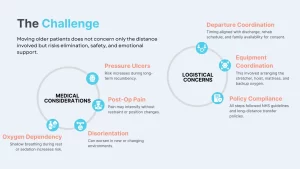
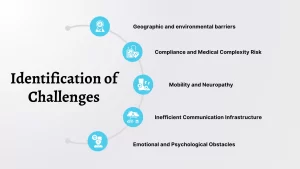
Moving older patients does not concern only the distance involved but risks elimination, safety, and emotional support.

Medical Considerations:

  • Vulnerability to pressure ulcers when in long-term recumbency
  • Post-operative pain which may increase in intensity without body-movement restraint and position-changing
  • Cognitive disorientation which may worsen during changes or new surroundings
  • Risk of oxygen dependency since breathing pattern is shallow during rest or sedation process

Even though Mrs. H. did not need any ventilator support or IV medication on the trip, her fragility put her at high risk of experiencing complications. Even minor problems such as the bumps on the road or emergency braking could provoke the discomfort or stress.

The Challenge

Logistical Concerns:

The 200-mile run required new routes to be mapped to meet the goal of efficient travel time and medical rest points

The act of departure had to be coordinated to:

  • The discharge process of the hospital
  • The schedule of visits at the rehabilitation facility
  • Availability of family to updates and consent

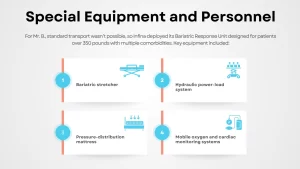
Coordination of equipment such as:

  • Back adjustable stretcher (high-back)
  • Patient hoist
  • Pressure-relieving mattress (padded) and back-up of oxygen

Adherence to NHS and long-distance transfer of patient’s policies.

Emotional and Communication Barriers

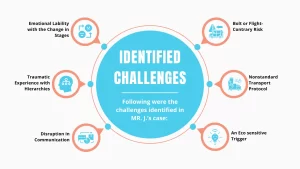
The presence of mild dementia created special emotional and behavioural issues in the process of planning and actual transportation of Mrs. R. She was mostly amenable but at times, her condition resulted in confusion, disorientation or sudden agitation especially in the change of familiarity of a particular environment or care give. Although it is possible to manage such instances in a clinical setting, extra attention is given in unknown and moving conditions like in an ambulance.

The primary caregiver, her daughter, was greatly worried about the emotional stability of her mother on the four-hour trip since the surgery. She underlined the value of consistency in emotional support, being non-confrontational and having the ability to see the state of her mother throughout each step. This required a more practical way of communicating by the transport team such as making calls to check in and send regular SMS messages, despite being on the road. The transport crew was oriented to all the emotional needs of Mrs. R. and educated on de-escalation techniques that are calm and reassuring in nature applicable to elderly patients who are cognitively impaired.

To make matters worse, receiving rehabilitation facility was only minimally staffed at night, and it was important that transport arrive within a certain window in the late afternoon. The delay would lead to non-availability of the right staff to help in patient intake, and this may pose a threat to the flow of care. These time issues created the sense of urgency in the coordination process, and to be able to provide incident-free punctuality without jeopardizing safety, Infina Health had to consider real-time traffic reports, delays in preparing patients, and weather changes.

Altogether, emotional, communicative components of the case demanded not only medical preparedness but also empathy-based planning and family focus coordination, which Infina Health had no issues in implementing as a part of their process.

3. The Response & Custom Strategy

Infina health went into the transfer with a holistic approach where a combination of the clinical needs, logistics and human care were balanced.

A. Pre-Trip Planning

Internal Coordination:

  • A senior coordinator of transport evaluated hospital discharge records.
  • An advisor in medicine examined the medicine, pain levels, and vitality.
  • The scheduling team at Infina assigned departure at 7 AM the following day so that morning nursing employees can get ready.

Communication Plan:

Close connection was made between:

  • The discharge nurse in hospital
  • Infina transport team
  • On-call nurse who works at the receiving facility
  • Family care giver to patient

Family was supplied with a digital itinerary, a temporal calculation of the expected time, and a hotline in case of an emergency

Crew:

  • Lead EMT certified in transportation of the elderly
  • Care Technician with trained communication and pressure sore management involved in dementia-friendly communication

Vehicle Modifications:

  • Anti-friction mattress overlay placed on padded stretcher
  • Oxygen flow meter cylinder pre-installed
  • Backboard, transfer sheet, non-slip gloves, privacy blanket on board
  • Interior cleaned and warmed to optimum comfort level

Medical Review

In the mornings of the transfer:

  • EMT carried out full vitals assessment BP 128/82, Temp 36.9 o C, HR 78 bpm, SpO 2 97 o C
  • Approved medications
  • Hospital nurse assisted patient in transit by taking her to the bathroom and having a light breakfast

Execution of Journey

7.15 AM- Departure

  • Full hoist support patient boarded.
  • EMT gave us directions, and the anticipated pit stops.
  • Level of pain registered as 2/10, and position changed after every 45 minutes.

9:00 AM- First Comfort Break

  • Stopped at service station.
  • Patient presented with hydration and assisted mobility activities.

11:00 AM Second Break + Status-update

  • Sending family, the notification via message, and visual check-in.
  • SpO 2 briefly fell to 94%, EMT was administered oxygen of 2 L/min, returning to 97%

12.15 PM – Arrival at Rehab Facility

  • Welcome, admitting nurse, physical therapist.
  • Hand off written: Final vitals shared: BP 122/78, Temp 37.0 C.

Human touch points

  • Play of soft music was done along the journey as per the choice of patients.
  • Crew had chatted to Mrs. H. a couple of minutes, gardening, books she was fond of.
  • Her panic attacks were diffused by reassuring and redirecting.

4. Results and Outcomes

Clinical Outcomes:

  • No pressure points, no increase of pain
  • Mild fluctuation of oxygen addressed in time
  • Stable BP, HR and mental acuity

Emotional Outcomes:

  • The patient referred to it as a feeling of peace and stated that she thought it would be frightening, but it was not.
  • There was high satisfaction rates related to updates and professional communication among family.

Institutional Outcomes:

  • In the pre-arrival documentation, rehab team praised the clarity of Infina.
  • Hospital discharge team implemented Infina Health as long-distance vendors on their approved list.

Infina Health strategic impact:

  • Consider using enhanced case study in sales and community outreach
  • Referred more long-distance transfers by 22 percent in subsequent quarter
  • Presented as a success story in the quarterly newsletter and the LinkedIn page of Infina

4. Results & Outcomes

Clinical Outcomes:

The situation during the flight of the transport crew was under rigid clinical protocols. The ensuing and constant surveillance revealed a steady heart rate and blood pressure, whereas mild fluctuations in oxygen saturation were also resolved at once, via immediately attainable and pre-set nasal oxygen assistance. To prevent pressure sores, the patient was turned every 45 minutes, and the padding was applied under her hips as she had been recently operated. There was no record of pressure areas or post trip inflammation. Her pain was effectively managed with scheduled medication and the same was provided as per physician instruction during journey.

The EMT on board also recorded the evidence of mental clarity. Mrs. H. was attentive, capable of answering questions, knew the common words, and surroundings. It was a crucial indicator of stability in a dementia patient and was one more confirmation that the transportation was clinically safe and held patient-centered perspectives.

Emotional Outcomes:

Mrs. H. was stunningly concerned with evident fear to get into the ambulance common in patients with mental disorders. Nevertheless, the EMT maintained a chatty conversation with her, spoke in soothing tones, and reassured her. Mrs. H. reported later that “it was not frightening but calm. I was looked after really well.” The emotional value of compassionate care in the conditions of the long-distance trip may hardly be overestimated, particularly in the elderly patient with an unstable mental condition

In the meantime, her daughter got five status messages through SMS and one voice message as she requested. These adopted changes were able to reduce her anxiety. She was thankful to the openness and the professionalism upon arrival, she said that “this was not merely transportation. It was care.

Institutional Outcomes:

The receiving rehabilitation facility complimented the detailed nature of pre-arrival documentation of Infina. They were supplied with a complete patient transfer sheet, a vitals log, and EMT notes. This helped in effective clinical handoff and helped in maximizing continued care of the patient without complications.

The discharge coordinator on the hospital side commended the responsiveness of Infina Health. She added, “the process took shorter than 24 hours from paperwork to pick up. We are going to put Infina on our favourites list when it comes to long hauls.” This official addition is a great step into business development.

Strategic Advantage to Infina Health:

It turned into an exemplary case of how Infina approaches the complexity of geriatric transfers with a medical, emotional, and logistical accuracy. After its successful execution a visual case summary was tested by the marketing and outreach team that was posted in the company Q2 newsletter and in LinkedIn, with a high response rate among the healthcare professionals.

Besides, the account managers observed 22 percent increase in the long-distance elderly transfer requests during the subsequent quarter. Two new associations with area hospitals were started who attributed their choice to Infina based on positive word of mouth and the accomplishments of communication that existed.

5. Conclusion & Recommendation

Key Takeaways:

1.      Older Transfers Will Require Full-Circle Planning

The transportation of elderly over long distances should not be a simple logistics affair. It involves the intense multi-level planning that involves dietary limitations, mental reinforcement, on-time medication, regulated temperature, and the presence of resting points in the case of an emergency. Stress among the dementia patients can also be lowered by having additional blankets, memory tools and distraction gadgets (such as soft music or picture cards).

2.      Real Time Communication Fosters Trust

The need to stay updated was not the preference that was faced by the daughter, it was a psychological need that was occasioned by love and concern. Real-time communication delivered over and over again transformed what might have been four anxious hours into a reassurance quest. The model used by Infina, namely, text + call, assisted in strengthening the sense of transparency and creating everlasting trust within the family.

3.      Experienced Crew Means Safe End Results

All the members of the crews engaged in geriatric patient care must be educated not only on medical procedures but also on emotional awareness. Infina personnel managed minor indicators such as shallow breathing and fidgeting with fingers which are signs of increasing distress effectively and calmly. By acting in advance, they did not allow minor problems to turn into huge crises.

4.      The Clinical Priority is Comfort

It is not a luxury to be comfortable; it is clinical care. The absence of pressure relief during long journeys, improper body positioning leads to the development of muscle strain, incidence of pressure ulcers, or other forms of psychological distress. Infina applies memory foam pad, reclining of stretchers, and shift of positions after short periods to counter these risks. The result is self-explanatory with no spikes of pain or complaints after the transportation.

5.      Long-Distance is no Less Personal

This trip demonstrated that long haul does not necessarily have to be sterile or chilly. Mrs. H. simulated her situation as being taken care of. The human aspect in the mission of Infina is seen in that remark. The difference was seen in perception as well as outcome attributable to a warm blanket, patient conversation, and gentle tone.

Suggestions on Future Transfers:

  • Cognitive pre-transfer baseline should always be checked to customize communication style on the road.
  • Formulate an emotional care checklist and clinical procedures.
  • Give the family a schedule and communicate through GPS tracking whenever possible.
  • Keep a spare replacement such as an additional oxygen tank and nutrient bars/waters.
  • Assign geriatric cases to those crew members who have had eldercare experience.

6. Conclusion

Infina Health has already demonstrated its all-inclusive care paradigm over this long distance, multi-party transfer, of aged patients. All the miles of “The Long Road Home” were conquered by preparations, professionalism and compassion.

Such a case not only gives emphasis on clinical efficiencies but also illuminates one of the most crucial truths: transport is an extension of healthcare. Medical transport is too frequently relegated as a logistic side note somewhere between discharge and admission. Infina Health defies that point and approaches every transfer as a singular experience of a patient, something that could shape outcomes, recovery, and peace that many families could enjoy.

The case of Mrs. Rosemary H. is not an exceptional one in the current world of elderly people. A large number of the aging patients end up in a situation requiring transport between hospitals and special long-term recovery facilities or long-term care facilities. These trips are not only geographical; these are emotional and medical transition. Infina understood that and reacted accordingly with a great deal of customer care that cannot be achieved in ordinary non-emergency care givers.

It was clinically prudent planning at the time Infina was referred the referral and planning until the minute Mrs. H. was in the secure admission. The ambulance was not only a car but an environment of mobile care that had everything to provide comfort and backup. The staff was not merely the crew, but the trained listeners, attentive observers, and defined practitioners. It wasn’t merely transactional communication but even empathic, anticipatory, and empowering the family.

The effectiveness of this case also demonstrates the way in which coordination between the various stakeholders can produce a smoother transition. Communication between the referring hospital and the operations team at Infina, the medical crew and the receiving rehab facility provided the continuity of care. This cooperation helped to decrease stress levels of all participants who had to cope with post-surgery inconveniences and dementia of Mrs. H.

RELATED
CASE STUDIES
Case Study: NEMT Services in Philadelphia for Better Healthcare Access 
December 11, 2024
Case Study: NEMT Services in Philadelphia for Better Healthcare Access 
Case Study: NEMT Services in Philadelphia How Our NEMT Services Transformed Healthcare Access for a Philadelphia Client  In the bustling city of Philadelphia, the importance...
Read More
Connecting Care: How Infina Enabled Quality of Life of a Diabetic Dialysis Patient
December 19, 2025
Connecting Care: How Infina Enabled Quality of Life of a Diabetic Dialysis Patient
1. Executive Summary Ms. Aisha M. was a 68-year-old woman resident of rural Worcestershire, who had to undertake significant difficulties in managing Type II diabetes,...
Read More