D. Considerations of Behavior
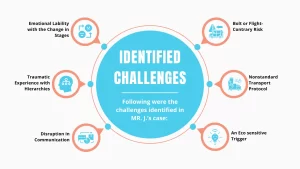
The additional layer of uncertainty was brought on by the dementia of Mr. A. He came to be susceptible to:
- Verbal agitation in strange places.
- Suspicion of strangers in uniforms (EMTs also).
- Fear of new developments in schedules.
Transport personnel was required to employ trauma-informed care methods: they had to speak slowly, and explain every action in advance, provide some comforting items (such as his favourite cardigan), and give a chance to get oriented at every stop. These minor gestures made it unlikely the rates of denial or confrontation would be high.
E. Documentation, Consent and Chain of Custody
Carrying a patient with delicate medical equipment was also a compliance issue:
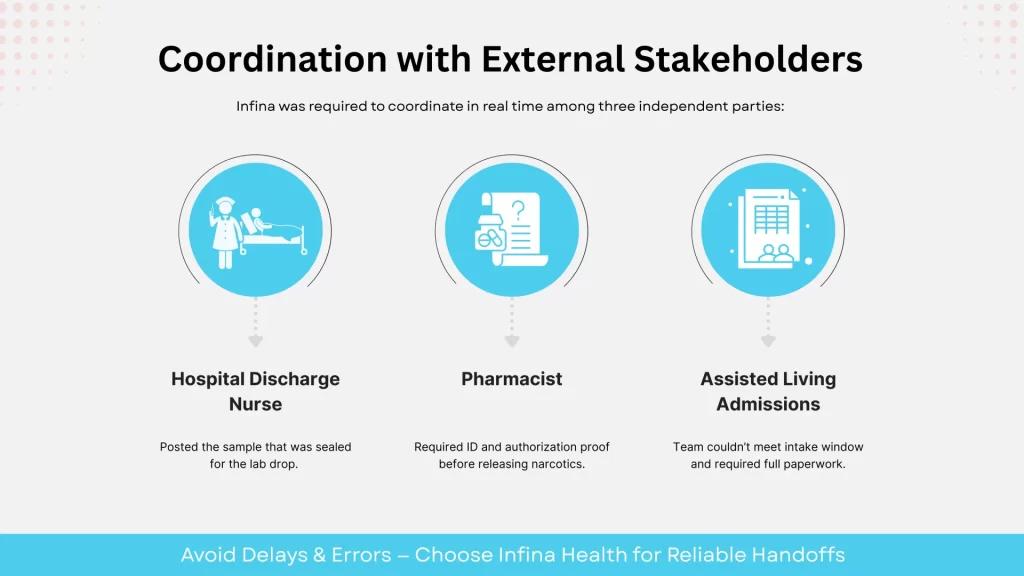
- Chain-of-custody would require time stamp and signature of samples in the laboratory.
- Controlled medications should have a pharmacy handoff form signed by a lead EMT of Infina.
- Paperwork needed to be recorded digitally and sent in real-time to the assisted living nurse in order to transition the care process.
Any failure in this would not only be a postponement in care rather it might lead to regulatory fines and jeopardized patient safety or legal actions.
4. Long Term Impact And Strategic Value
Although the direct aim of transporting Mr. A. was to guarantee his safe moving to a residential facility, there was a lot more to be done with this mission than when it comes to one transport. This case showed how a properly planned, time-sensitive, multi-stop medical transportation can influence the long-term health outcomes, eliminate the gamble of hospital readmission and form a more consistent continuity of care between providers. What is more important, it depicted the strategic positioning of Infina Health as the element of the healthcare ecosystem, the role of which is not to deliver a transport service only, but to play the part of clinical partner in transitional care.
A. A New Discharge Model of Complexity
The incident of transport led to the change in system at Grandview Regional Hospital. In the past, discharge planning was somewhat linear ensuring that it gets patients out of bed to the door. However, Mr. The case of A demonstrated how vulnerability patients can gain a lot when transportation is considered as a part of medical care, not a logistically related appendage. System-wide discharge procedures, especially of patients with several comorbidities or behavioral issues, were adjusted with the help of hospital administrators working together with the clinical transport team of Infina.
Leveraging the experience gained with the new protocol, early transport consult, during discharge planning, is now part and parcel of the protocol, and clinicians are now advised to think about alternative multi-stop medical transportation, particularly when there is a need to make detours to visit a pharmacy, a lab, or other administrative work. Through this proactive model of coordination, the risk of delays is minimized at the last minute, and there is continuity of medication as well as enhancing the safety of patients.
B. Improved Hospital-Community Connection
The presence of Infina intervening to Mr. The transition of A aided in developing a stronger connection between the acute care providers and the community-based care givers. There was a good handoff with live updates to the assisted living facility, with written notes of prescriptions and labs, and a hand-to-hand transfer between EMTs and the nursing team.
The physical and emotional needs of A on the way there -hydration, comfort, safe transportation- the process of transportation brought him to the facility ready to spend some time in an effective way, without stress, strangely enough. This enabled his home care plan to start immediately and without any misunderstanding, which strengthened the trust in Infina as well as the discharge process of the Grandview Hospital. Infina has since been increasing its number of referrals as regards such transitions and this shows its status as a trusted partner in patient care based in the community.
D. Potential of Replication
Making the conclusion according to the experience of the work of this mission, Infina came up with a new internal system known as the Complex Discharge Transport Track. In this program there are:
- Multi-stop cases have pre-discharge forms of coordination
- Real time updates of external facilities communication templates
- Lab-sample and prescription chain-of-custody checklists
- Sensitization courses on how to handle dementia-caused behavioural issues
- Time calculator to maximize the productivity of routes in stressful situations
The leadership of Infina introduced the playbook at one of the regional hospital networks meetings, where it sparked the interest of other facilities interested in enhancing discharge performance.
A number of pilot projects are currently being implemented. As they have transformed a high stakes challenge into a replicable model, Infina is pioneering the future of transitional care and raising industry standards of medically integrated transport.
5. Stakeholders Comments
What can best demonstrate real impact not only in terms of data and protocols but also in terms of the words of the people that have been directly involved. The complicated case of A discharge was not only operational, but very human. These are the words of main stakeholders that show the emotional stability, respect to professions involved and their new self-esteem that appeared after the considerate approach of transport by Infina. Every voice refers to a distinct aspect of the experience and, together, these voices are united in their experience of excellence resulting in a standard hospital staff, family members, and receiving care providers.
Hospital Perspective
Nurse on work on Grandview Regional Hospital:
“Infina converted what would have been a domino of issues to a domino of solved issues.”
It was a stressful day and the hospital discharge nurse reported that there was a series of delays already affecting the system. She thought that transport would be one other stumbling block, yet, the team at Infina was so organized that it has been one turning point in the road to victory. The pre-arrival preparation they had, getting their medication and the timing made the hospital staff confident that Mr. A was taken care of well.
6. Family Member Insight
Mr. A’s daughter:
“The older man seemed to have people that cared around him. That is all we wished.”
To the family, transition was an emotional event. Mr. Sudden change was hard with A, who did not want to be confused or upset on the journey. However, they made reports that the staff of Infina spent more time, discussing things peacefully and taking their time to explain each procedure thoroughly and treat Mr. A. quite patiently and respectfully. Such little acts offered a huge difference emotionally to a family which was attempting to have balance between medical issues and emotional closure.
Experience in Receiving Facility
Nurse practitioner at the Assisted Living Facility:
“I have never had such a clean handoff of a patient as transport. Vitals, meds even, mood notes; it helped us do our job easier.”
The receiving nurse was impressed especially with the clinical completeness of transfer. Not only did Infina deliver medications and the lab sample with the documentation still, but they were giving verbal updates on Mr. The vitals of A on transport, behaviour and food diaries. Such a degree of communication also removed the guesswork aspect of the new care team with Mr. They are offered a smooth, well-informed onboarding.
7. Conclusion
The long, convoluted, and exhausting discharge process of Mr. A act as an impressive exhibition of what can be done with healthcare logistics when compassion, medical diligence, and technological perfection collide. In such a high stakes case, Infina Health went beyond non-emergency medical transport to bring a peace of mind, safety and continuity of care that was never imagined in the scope of traditional discharge services.
In essence, this case served as a reminder of a rising trend in the current healthcare spectrum: as patients get older, more medically complex, and increasingly dependent on post-acute health facilities, the change of geography cannot be viewed as a simple transfer. It has to be considered as the last and decisive phase of acute care. In the case of Mr. A, there was no margin of error in this last stage. There was a limited time, the level of comorbidities was riskful, and the emotional and behavioral characteristics of dementia built an additional level of complexity.
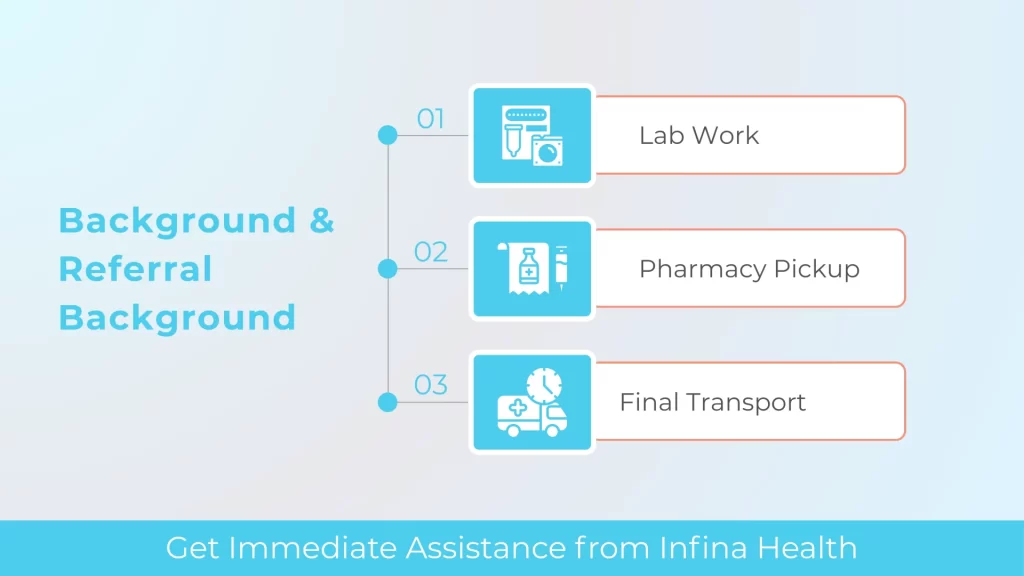
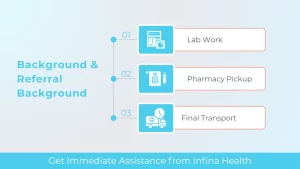
Infina has considered the model of multi-stop transport organization not only as a stop-gap measure, but also as a re-definition. By coordinating pharmacy pick-up, lab delivery and patient handoff into a tight two-hour time frame, the team demonstrated that such complicated, high touch transitions could be done without issues- as long as enabled by the right tools, the right training and the right attitude. This was no win to just handle logistics, it was to manage patient services via transit.
Infina has considered the model of multi-stop transport organization not only as a stop-gap measure, but also as a re-definition. By coordinating pharmacy pick-up, lab delivery and patient handoff into a tight two-hour time frame, the team demonstrated that such complicated, high touch transitions could be done without issues- as long as enabled by the right tools, the right training and the right attitude. This was no win to just handle logistics, it was to manage patient services via transit.
The aftershocks of this case were significant and quantifiable. Grandview Regional Hospital dynamited her discharge protocols. The intake facility projected increased readiness and less stress upon admission. Even the family of the patient, the most important stakeholder of them all felt happy that the patient was not just transported but was indeed looked after throughout the process.
Most critically, on the back of this case, scalable impact was pre-conditioned. Out of it came the so-called Complex Discharge Transport Track, which describes a codified, repeatable system at Infina to deliver the same quality to future patients. By doing so, Infina has not only set the level of its own service standards, but it has also shaped a sea change in how hospitals, pharmacies and long-term care facilities all work together to seal the care chain.
The fact that Infina Health came out successful with this transport was not a matter of chance but the situational performance of preparation, innovation and commitment of transport being treated as care. And with that they did not merely secure Mr. A from point A to B. They aided in establishing a new national benchmark regarding what high-complexity non-emergency medical transport services to patients should be.